Cybersecurity Vs. Data Analytics: Which Career Path is Right for You?
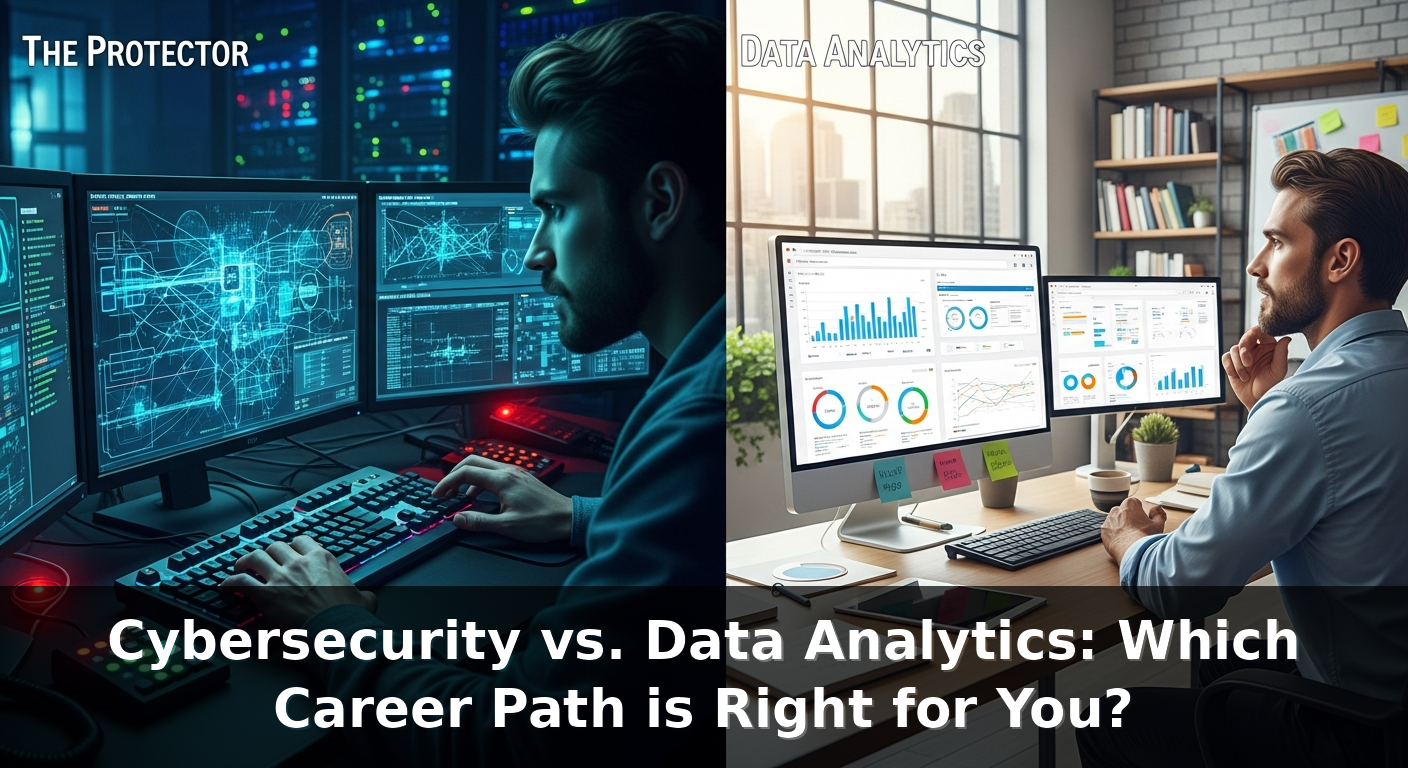
Table of Contents
- 1. What is the difference between cybersecurity and data analysis?
- 2. The reason why it is important to compare cybersecurity and data analysis
- 3. How to Get Started
- 4. Frequently Asked Questions
- 5. Conclusion
Nowadays, choosing a career path is like standing at a crossroads. There are two fields that constantly attract attention and draw talented individuals who seek growth and tangible impact. These are cybersecurity and data analysis. Both fields are very important in our digital world and shape how businesses operate, the flow of information, and how we use technology in our daily lives. However, although both fields deal with data, their goals, day-to-day tasks, and required skill sets are completely different.
While many people think about these options, they question which one would best suit their interests, skills, and long-term career goals. What is important is not just whether a choice is generally popular, but finding a role where you can truly succeed and make a meaningful contribution. Understanding the key differences and commonalities is the key to making smart decisions about your own future. Here, the differences between cybersecurity and data analysis are clearly explained, and the content of each career is presented in detail, allowing you to choose the path that suits you best.
What is the difference between cybersecurity and data analysis?
Let's clarify exactly what this field encompasses. When we talk about cybersecurity, we are essentially talking about defense. It is the practice of protecting computer systems, networks, and data from digital attacks, damage, and unauthorized access. You can think of it as building and maintaining a fortress around an organization's most important digital assets. Experts in this field are always on alert. They establish security protocols, monitor systems, detect suspicious activities, and respond quickly if a breach occurs.
Typical tasks may include assessing security vulnerabilities using tools like Nessus or Qualys and updating systems to address these vulnerabilities. Additionally, these individuals may manage firewalls, intrusion detection systems (IDS), and security information and event management (SIEM) platforms such as Splunk or Elastic Security. The main goal is to protect data and ensure that sensitive information is accessed and used only by authorized users. This involves developing and implementing a strong risk management strategy, preventing ransomware attacks, and protecting intellectual property. Roles in this field include security analysts, incident response specialists, penetration testers, and security engineers. This field requires constant challenge because it is necessary to anticipate threats and always stay one step ahead of attackers; it demands sharp defensive awareness and deep technical knowledge about system abuse methods.
On the other hand, data analysis is about exploration and deep understanding. While cybersecurity experts protect data, data analysts use this data to find patterns, draw conclusions, and support better business decisions. They are like detectives; they examine vast amounts of information such as sales figures, customer behaviors, and operational indicators and uncover significant trends. They are not concerned with preventing attacks, but with understanding what data tells us about the world.
A day in the life of a data analyst may involve organizing messy datasets, writing complex SQL queries, building predictive models using Python or R, and creating clear and impactful dashboards with tools like Tableau or Power BI. Their goal is to transform raw data into practical business insights. For example, this could involve analyzing customer purchase history to forecast future demand or identifying areas that can improve operational efficiency. This field is an important component of many data science career paths and supports every area from marketing campaigns to product development. They contribute to areas such as predictive analytics, understanding customer churn, and improving the supply chain. This requires curiosity, strong statistical skills, and the ability to tell stories with numbers.
The reason why it is important to compare cybersecurity and data analysis
Choosing between cybersecurity and data analytics is not a simple theoretical matter; it is a decision that genuinely affects your career path, the way you perform your daily tasks, and your long-term satisfaction. Both fields are growing at an incredible pace, yet each supports different roles that are equally important in a world increasingly dependent on and interconnected through data. Understanding why each is important can help you determine where you can make the greatest impact.
Cybersecurity is becoming increasingly important because digital threats have not disappeared. All organizations, from small businesses to multinational companies, are at risk of attempted attacks on their systems. Even a single data breach can result in losses worth millions of dollars, damage to reputation, and even business interruption. The demand for cybersecurity experts specialized in threat detection and vulnerability assessment continually exceeds supply. The U.S. Bureau of Labor Statistics predicts that the occupation of information security analyst will grow by 32% from 2022 to 2032, far above the average for all occupations. In 2022, the average salary was around $120,000. This profession carries high risk and has a significant impact; the work you do involves directly protecting personal data, financial information, and national security.
Data analysis is important. The reason for this is that companies often lack insights despite being buried in large amounts of data. Companies need skilled individuals who can understand this information in order to stay competitive, understand their customers, and drive innovation. In situations such as increasing marketing ROI or making production processes more efficient, data analysts provide the necessary evidence to make informed decisions. Additionally, the profession of data scientist or analyst is experiencing significant growth; the U.S. Bureau of Labor Statistics (BLS) predicts that data scientist jobs will increase by 35% from 2022 to 2032, and the average salary in 2022 is approximately $108,000. This career path offers the satisfaction of uncovering hidden patterns and directly influencing strategies through tangible results, which largely leads to the growth of the job.
"The fundamental difference is not just limited to the tools; it also involves the way of thinking. While cybersecurity experts think like attackers to defend, data analysts think like scientists to explore. The passion for defense and the passion for exploration will largely show you where you belong." - Dr. Eveline Reed, career advisor in the field of technology
I am providing a simple comparison to help organize thoughts about skill sets, market trends, and career development opportunities.
| Feature | Cybersecurity | Data Analytics |
|---|---|---|
| Primary Goal | Protecting the system and data from threats. | Deriving ideas or patterns from data. |
| Core Mindset | Defensive, cautious, and very skeptical. | A curious, analytical, and problem-solving person. |
| Key Skills | Understanding of networking, risk management, security protocols, scripting (Python, PowerShell), incident response, and operating systems. | Statistics, programming (Python, R, SQL), data visualization, machine learning, business understanding. |
| Common Tools | Firewall, SIEM (Splunk, QRadar), EDR, Wireshark, Nmap, vulnerability scanning software. | SQL, Python (Pandas, NumPy), R, Tableau, Power BI, Excel, Jupyter notebooks. |
| Impact on Business | Prevents financial losses, protects reputation, and ensures regulatory compliance. | It guides the strategy, improves operations, identifies new opportunities, and provides information for product development. |
| Starting salary range (USD) | $70,000 - $95,000 | $65,000 - $90,000 |
Both fields offer strong career opportunities and good salary prospects, but the day-to-day realities and the types of problems encountered are completely different. Which field you choose depends on whether you are drawn to the thrill of protecting digital assets from malicious attacks or the satisfaction of uncovering hidden stories in complex data sets.
How to Get Started
Now, you are carefully considering your options, questioning what truly excites you, and your heart may be leaning toward one path at the moment. Or you may still have doubts, but that is completely natural as well. The next logical step is to really know which field to enter. Both cybersecurity and data analysis have high growth potential, and companies are always looking for smart and ambitious talent. However, these fields require certain skills or knowledge. Now let's look at the practical steps.
If you are interested in cybersecurity, it would be a good idea to start by learning the basics of information technology. Consider learning operating systems like Linux or Windows servers or understanding the fundamental concepts of networks. Certifications are very important. CompTIA Security+ is an excellent choice for beginners and covers a wide range of security topics. Later, you might consider CompTIA CySA+ to develop analytical skills or the Certified Ethical Hacker (CEH) certification for penetration testing. Advanced professionals often aim for the CISSP certification, but this requires years of practical experience. Education can be obtained with a degree in computer science or information security, or through intensive bootcamps that allow you to enter the field faster. Practical experience is crucial. Set up a lab at home and practice analyzing network traffic using tools like Wireshark, learn programming with Python or PowerShell, and gain hands-on experience on platforms like TryHackMe or Hack The Box. These kinds of hands-on activities are what hiring managers really want to see on a resume. Don't just read books; apply what you learn in practice.
If you are more interested in data analysis, you need to build a solid foundation in statistics and mathematics. Understanding how numbers work is essential. Since SQL is a fundamental skill for those working with databases, let's start here. Then, learn programming languages like Python or R. Both are quite powerful in data processing and analysis. For data visualization, tools like Tableau or Microsoft Power BI are industry standards. Strong certifications are also available for beginners, such as Google's Data Analytics Certificate or IBM's Professional Data Analyst Certificate. Many universities offer master's programs focused on data science or analytics, but usually, a bachelor's degree in a quantitative field, online courses, and a solid project portfolio are sufficient. To gain practical experience in data analysis or cybersecurity, you need to work with real datasets. Check out Kaggle and find projects that interest you, clean the data, analyze it, and visualize it. Creating a project portfolio that showcases your skills acts as a kind of business card for you. Whichever path you choose between cybersecurity and data analysis, continuous learning is key. Since both fields are constantly evolving, keep your curiosity alive and continue developing your skills.
Frequently Asked Questions
What is the difference between cybersecurity and data analysis?
Cybersecurity focuses on protecting computer systems, networks, and digital assets such as data from theft, damage, or unauthorized access. This includes attack prevention, breach detection, and incident response. Think of it like firewalls, encryption, threat intelligence, and vulnerability assessments being parts of this area. The goal is to protect the confidentiality, integrity, and availability of information. On the other hand, data analysis involves extracting meaningful insights and patterns from raw data to support decision-making processes. Analysts collect, clean, transform, and model data to uncover trends, predict outcomes, and improve processes. This often involves statistical analysis, machine learning, and data visualization. While the primary goals are different, both fields rely heavily on analytical thinking and sometimes intersect, such as applying data analysis techniques to security logs in the field of security analysis.
Conclusion
Choosing between cybersecurity and data analysis is not a matter of good or bad choice; it's about choosing one of two valuable and high-demand career paths. In fact, it depends on your core interests and your natural strengths. Does protecting systems, identifying vulnerabilities, and outsmarting malicious actors excite you? Then cybersecurity might be your field. Does uncovering hidden patterns in data, solving complex problems with numbers, and developing business strategies from insights excite you? Then data analysis might be the right choice. Both fields require strong problem-solving skills, critical thinking abilities, and a commitment to continuous learning. Since technology evolves rapidly, staying up-to-date is not just a suggestion; it's a necessity. Take some introductory courses, practice, and actually talk to people working in the field. Your passion will guide you to the right path. And whichever path you choose, you can find a fulfilling career at the forefront of the digital world.
Related Articles
- Why Cybersecurity Career: is it the Right Path for You?
Table of Contents1. Why the profession of cybersecurity?2. Why are cybersecurity professions considered important?3.... - Cybersecurity Vs Data Science: a Career Path Showdown
Table of Contents1. What is the difference between cybersecurity and data science?2. Why is the comparison between... - Cybersecurity Vs Software Engineering: Which Career Path?
Table of Contents1. What is the difference between cybersecurity and software engineering?2. Why is cybersecurity... - What is Cybersecurity Engineering? Roles, Skills, & Career Path in 2026
Table of Contents1. What is cybersecurity engineering?2. The reason why cybersecurity engineering is important3. How to...